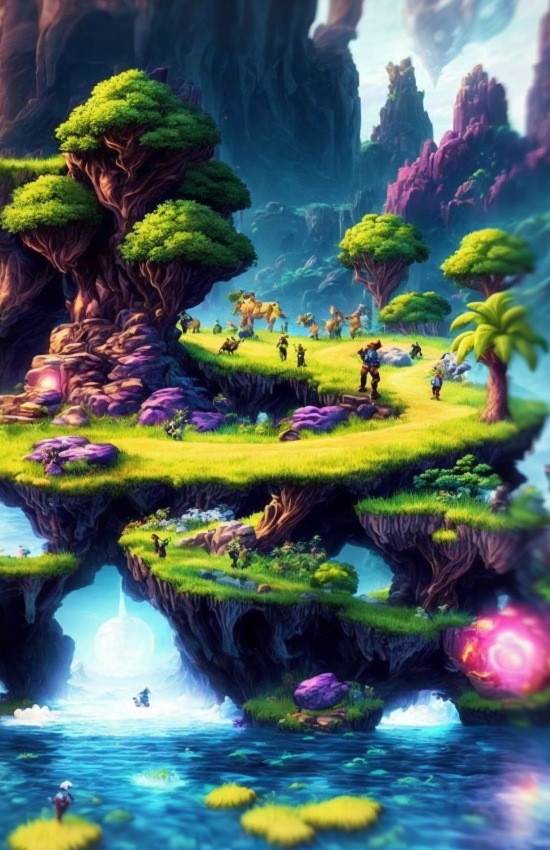
In an ever-evolving realm of digital creation, where the art of gaming intersects with the craft of coding, emerges a framework that beckons the simplicity and elegance of 2D universes. Imagine a tool that breathes life into flat landscapes, conjuring realms for adventurers, crafted not by the bulky engines of yore but streamlined for the nimble threads of modern computation.
Enter a domain where entities are the soul, and components are their versatile spirits, allowing for boundless behavior within these digital dreamscapes. Secrets of the game’s heart lie in an arcane dictionary of global variables, stirring entities to action with every pulse of change.
Scenes, the virtual stages of innovation, harbor these entities, each oblivious to their counterparts in parallel worlds. Only one scene may illuminate the screen’s canvas at a time, presided over by a class known as Game, the grand conductor of this symphony of pixels.
Behold the elementary spirits of this framework: the Transform, which dictates spatial essence; the Label, whisperer of aliases; the SpriteRenderer, painter of digital sprites; the Animator, puppeteer of motion; complemented by vision through the Camera, the auditory echo of AudioSource, the geometry of CircleCollider and BoxCollider, and the tactile reality of Rigidbody.
Scripted incantations grant customized breath to each entity, while an acolyte class, Input, interprets the will of the external deities—players engaging through keystrokes and mouse-clicks. Sculpted in the tongue of C# and the arcane runes of OpenGL and OpenAL, this framework, a mosaic of OpenTK library, stands as a testament to the ingenuity of creators, a beacon for the artificers of virtual tales in two-dimensional spaces.